What Is Crypto Address Poisoning and How to Avoid Losing Funds Through Address Substitution
Cryptocurrency transactions offer speed, transparency and direct control over digital assets, but they also come with unique security challenges. Unlike traditional bank transfers, most blockchain transactions cannot be cancelled or reversed after confirmation. This means that a single mistake when entering a wallet address can lead to permanent financial loss. One scam that has become increasingly common across major blockchain networks is crypto address poisoning. Rather than exploiting weaknesses in blockchain technology, this attack targets human behaviour and attempts to trick users into sending funds to fraudulent wallet addresses. Understanding how address poisoning works and how to recognise its warning signs is essential for anyone who holds or transfers cryptocurrency in 2026.
What Is Crypto Address Poisoning and How Does It Work?
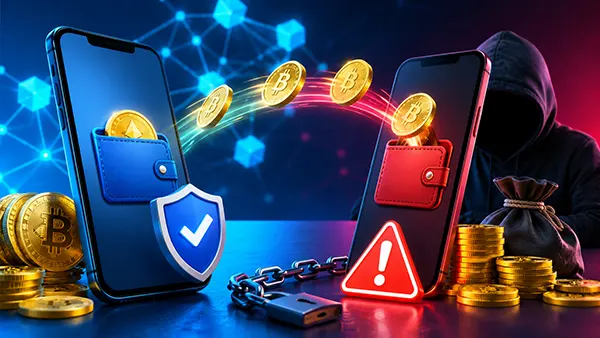
Crypto address poisoning is a scam in which criminals deliberately place a fraudulent wallet address into a victim’s transaction history. The attacker generates an address that closely resembles a legitimate address previously used by the target. In many cases, the first and last characters are identical, making the address appear familiar when viewed quickly.
After creating a similar-looking address, the attacker sends a very small amount of cryptocurrency or a low-value token to the victim’s wallet. The transfer itself has little financial significance. Its main purpose is to ensure that the fake address appears in the wallet’s transaction records, where it may later be mistaken for a legitimate recipient address.
The scam succeeds when a user copies the fraudulent address from their transaction history instead of obtaining the correct address from a trusted source. Because blockchain transactions are generally irreversible, any cryptocurrency sent to the attacker’s address is usually impossible to recover.
Why Address Poisoning Has Become More Common
The popularity of cryptocurrency has increased significantly over the past few years, bringing millions of new users into the market. Many of these users interact with multiple wallets, exchanges and decentralised applications, making it more difficult to keep track of every address they use.
At the same time, attackers have access to automated tools capable of generating large numbers of wallet addresses. These tools can search for addresses that match specific character patterns, allowing criminals to create convincing lookalike addresses with relatively little effort.
The attack is also attractive because it requires no direct compromise of the victim’s device or account. Criminals do not need passwords, recovery phrases or private keys. Instead, they rely entirely on distraction, routine behaviour and insufficient address verification.
Recognising the Warning Signs of Address Poisoning Attempts
One of the clearest indicators of address poisoning is the appearance of unexpected micro-transactions within a wallet. Users may notice transfers involving tiny amounts of cryptocurrency from unknown addresses that they have never interacted with before.
Another warning sign is receiving unfamiliar tokens without having purchased or requested them. Some scammers use token spam campaigns alongside address poisoning attacks to increase the visibility of fraudulent addresses and encourage users to inspect their transaction history.
Wallet owners should also be cautious when reviewing past transactions. If an address appears similar to a frequently used destination but differs in several characters, especially in the middle section of the address, it may be part of an address poisoning attempt.
Blockchain Networks Frequently Targeted by Attackers
Ethereum remains one of the most targeted blockchain ecosystems due to its large number of active users and publicly accessible transaction records. Address poisoning attacks have been observed across Ethereum mainnet and many Ethereum-compatible networks.
Similar scams have also appeared on BNB Chain, Polygon, Arbitrum, Optimism, Avalanche and Base. Because these networks support low transaction fees, attackers can conduct poisoning campaigns at minimal cost while targeting a large number of wallets.
Bitcoin users are also exposed to this threat. Although Bitcoin addresses use different formats, criminals can still create addresses that resemble legitimate destinations. The underlying principle remains the same: exploiting users who rely on visual similarity instead of complete verification.
Practical Steps to Protect Cryptocurrency Assets
The most effective defence against address poisoning is verifying the entire wallet address before every transaction. Users should compare all characters rather than checking only the beginning and end of an address. This simple habit significantly reduces the risk of sending funds to a fraudulent destination.
Many modern wallets include address books that allow trusted addresses to be saved under custom labels. Using this feature helps eliminate the need to copy addresses from transaction histories, where poisoned addresses may appear alongside legitimate records.
For large transfers, security professionals continue to recommend sending a small test transaction first. Confirming that funds arrive at the intended destination before transferring a larger amount provides an additional layer of protection against mistakes and scams.
Long-Term Security Habits for Safer Cryptocurrency Use
Hardware wallets remain one of the strongest security tools available to cryptocurrency holders. These devices display transaction details independently from the connected computer or smartphone, allowing users to verify recipient addresses directly before approval.
Keeping wallet software updated is equally important. Developers regularly release security improvements, interface enhancements and warning systems that can help users identify suspicious transactions and potentially dangerous activity.
Ultimately, preventing losses from address poisoning depends on maintaining disciplined security practices. Taking a few extra moments to verify wallet addresses, avoiding shortcuts when copying transaction details and reviewing every transfer carefully can help ensure that digital assets remain secure even as cryptocurrency scams continue to evolve.